Literary Devices
Literary devices
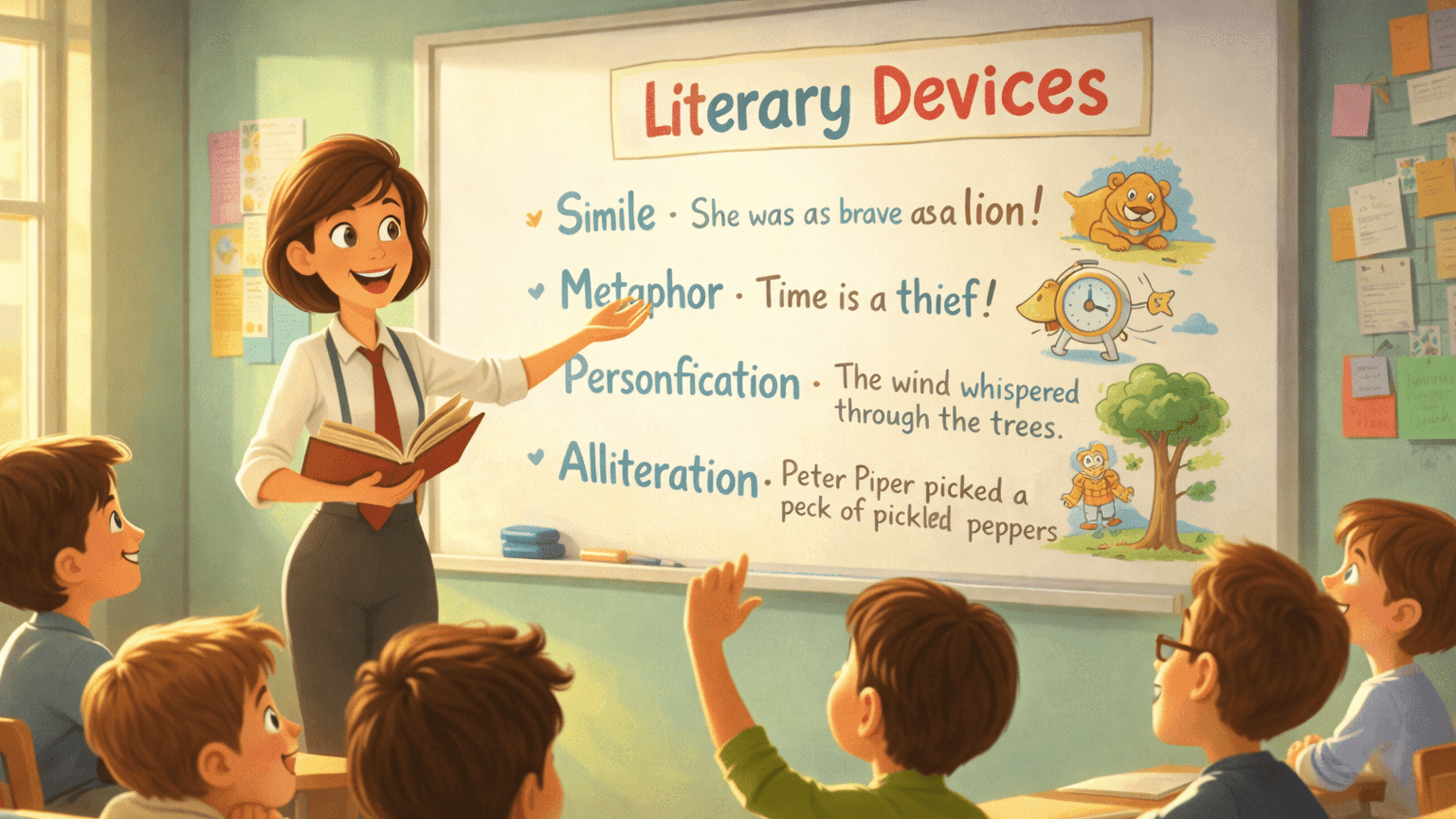
A literary device is a technique a writer uses to make their writing clearer, more interesting, or more powerful.
Writers use literary devices to:
Create strong pictures in the reader’s mind
Show feelings and emotions
Make ideas easier to understand
Make writing more memorable
Examples:
"
The classroom was a zoo.
This makes the classroom sound noisy and busy, even though it is not really a zoo.
"
The wind whispered through the trees.
This makes the wind seem gentle and alive, helping the reader imagine the sound and movement.
Similies
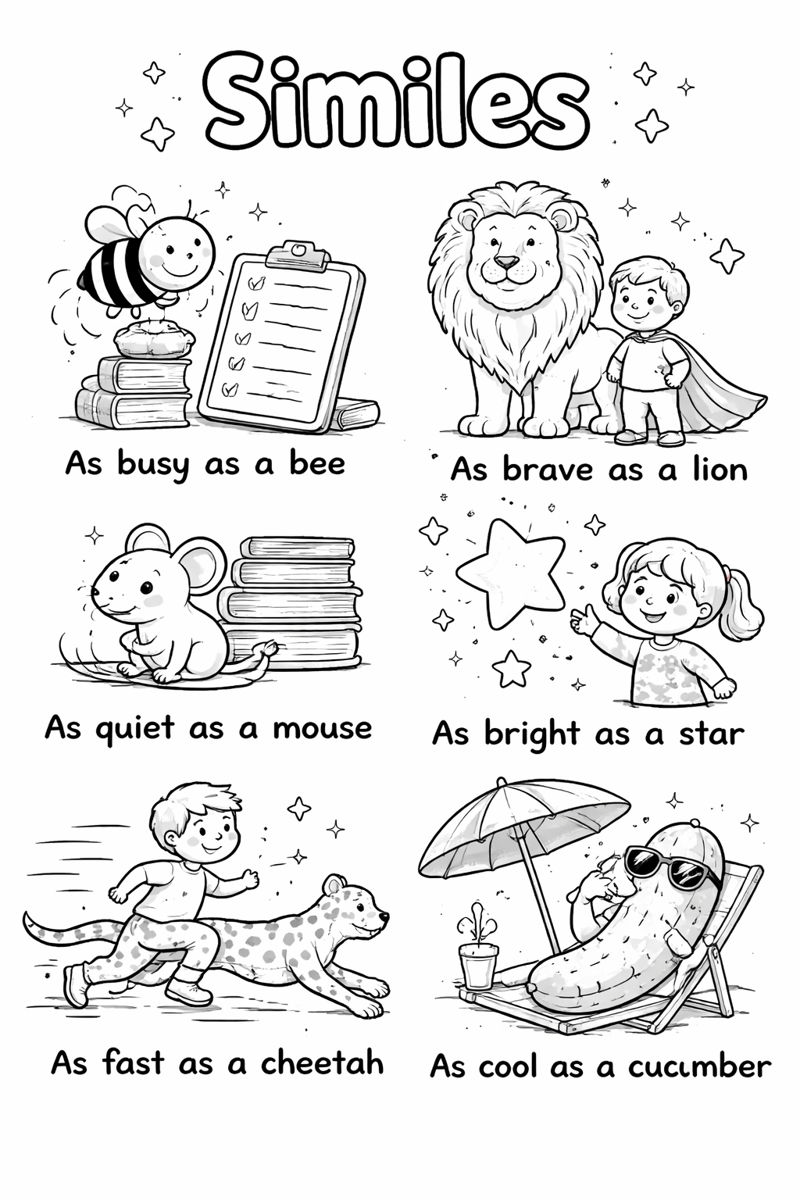
A simile compares two different things using the words like or as.
The boy ran like the wind.
"
The boy ran fast
Her smile was as bright as the sun.
"
Her smile was very bright
Tip:
If you see like or as in a comparison, it is usually a simile.
Similies
Metaphor
A metaphor compares two things by saying one thing is another thing.
Metaphors help make ideas stronger and more memorable.
The room was a beehive of activity
"
The room was very busy
Time is a thief.
"
Time is taking something from us
Metaphor
A metaphor compares two things by saying one thing is another thing.
Metaphors help make ideas stronger and more memorable.
How is this different from a simile?
• A simile uses like or as.
• A metaphor does not use like or as.
Tip:
If something is described as if it really is something else, it is probably a metaphor.
Personification
Personification means giving human qualities to animals, objects, or ideas.
It helps the reader imagine things more clearly and makes writing more interesting.
Personification
Personification means giving human qualities to animals, objects, or ideas.
It helps the reader imagine things more clearly and makes writing more interesting.
Examples:
“The wind whispered through the trees.”
“The angry storm punched the windows.”
Personification
Examples:
“The wind whispered through the trees.”
“The angry storm punched the windows.”
What to look for:
Objects doing human actions
Nature acting like a person
Feelings given to things that are not alive
Personification
What to look for:
Objects doing human actions
Nature acting like a person
Feelings given to things that are not alive
Tip:
If something that is not human is described as thinking, speaking, or acting like a person, it is personification.
Alliteration
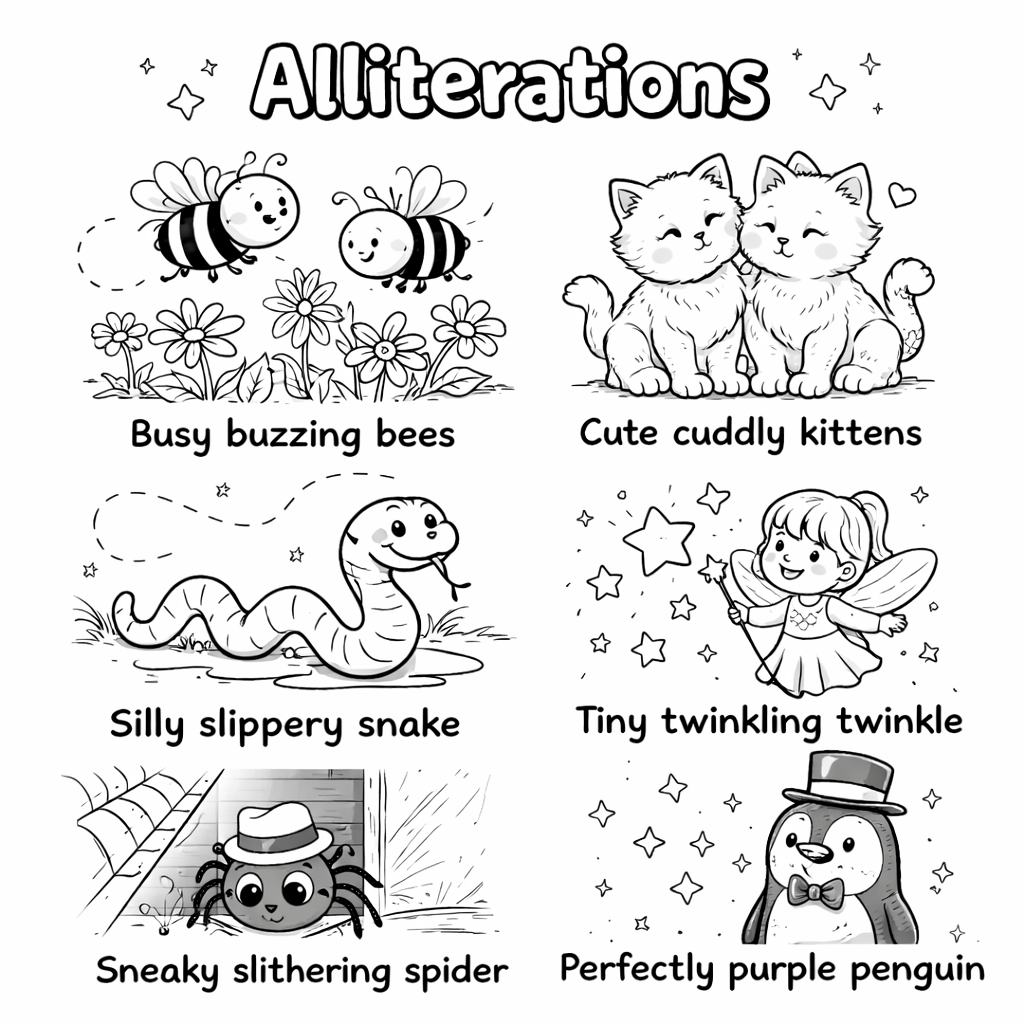
Alliteration is when the same sound is repeated at the start of nearby words.
Writers use alliteration to make phrases catchy, fun, and memorable.
Alliteration
Alliteration
Note that alliterations are based on sound, so "c" and "k" form an alliteration here.
A "c" and an "s" could also make an alliteration if they are pronounced the same, like in "small, silly cities".
Alliteration
What to look for:
Repeated starting sounds
Often used in poems, stories, and slogans
Onomatopoeia
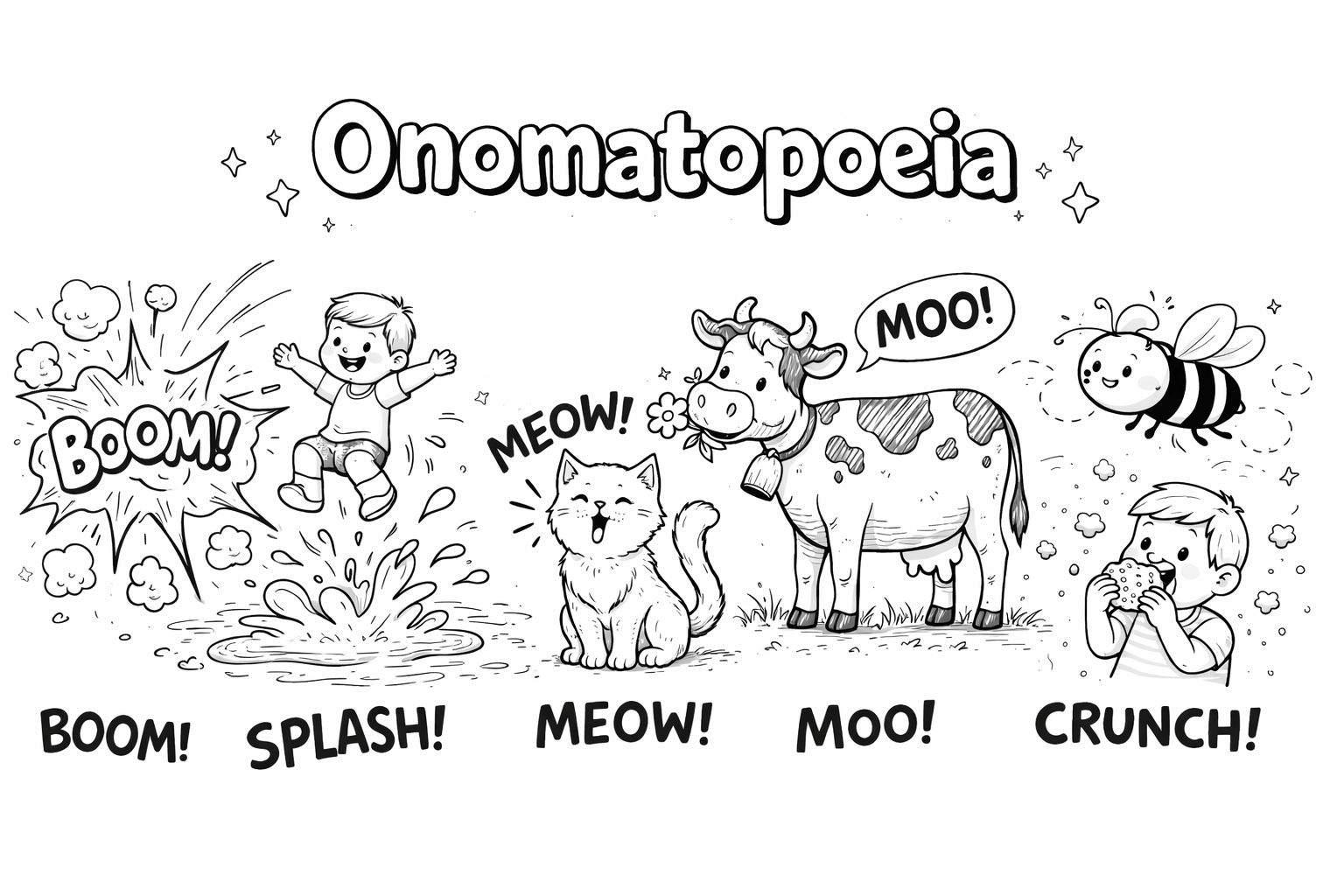
Onomatopoeia means a word that sounds like the noise it describes.
These words help bring writing to life by letting the reader hear the action.
Onomatopoeia
Onomatopoeia
Some other examples:
“The balloon went pop.”
“The bees went buzz around the flowers.”
“The fireworks went bang.”
Even "creaked" is often considered an onomatopoeia.
Onomatopoeia
What to listen for:
Words that copy real sounds
Often used in stories, comics, and poems
Tip:
If the word sounds like the noise it describes, it is probably onomatopoeia.
Hyperbole
Hyperbole means using exaggeration to make something sound stronger, funnier, or more exciting.
It is not meant to be taken literally.
Hyperbole
I’ve told you a million times.
"
The speaker does not claim to have said something literally "one million time". It is just intended as an interesting or funny way of saying "many".
Hyperbole
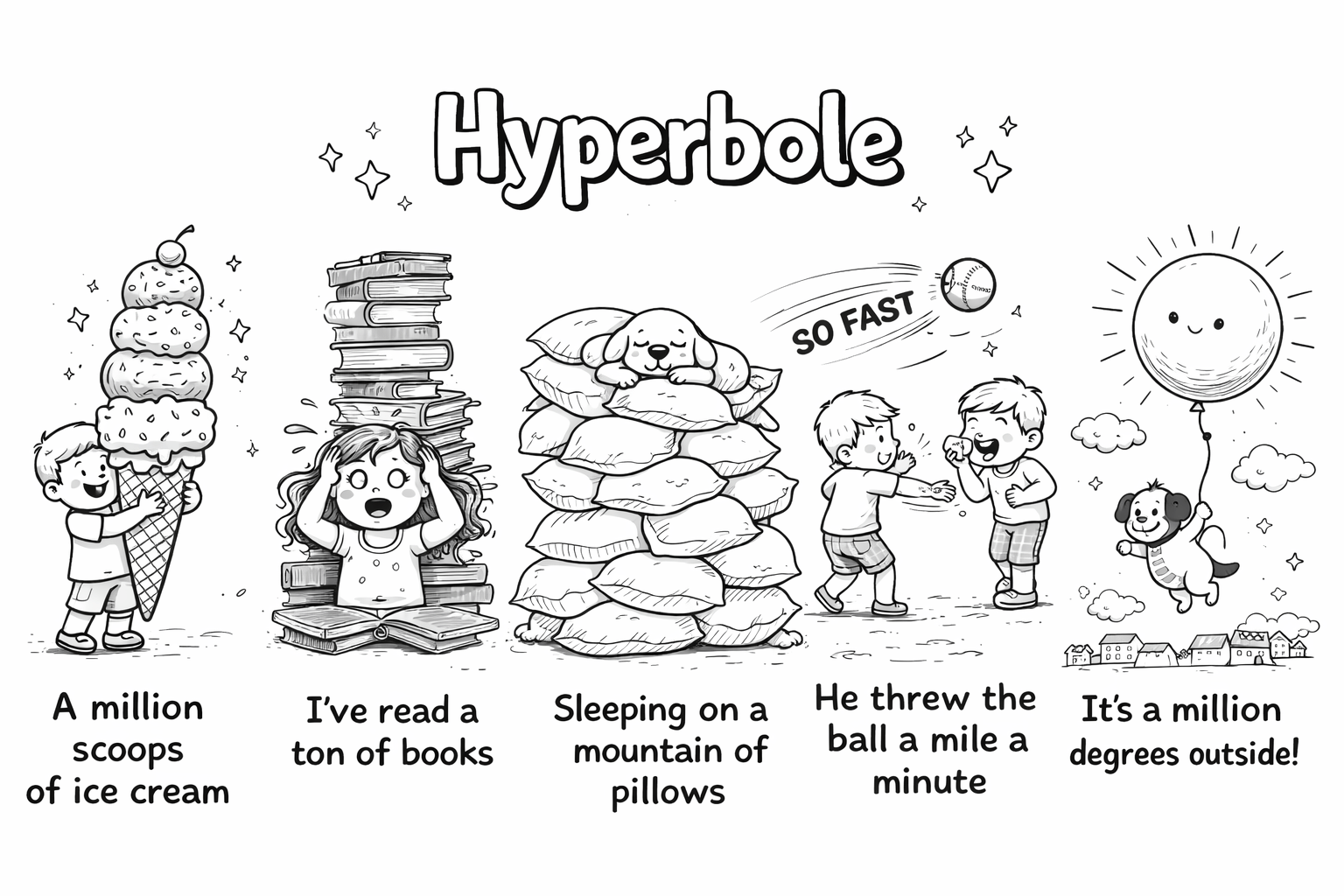
Hyperbole
Why writers use hyperbole:
To add humour
To show strong feelings
To make descriptions more dramatic
Tip:
If something sounds impossible or hugely exaggerated, it is probably hyperbole.
Idiom
An idiom is a phrase that does not mean exactly what the words say.
The meaning is understood by people who know the language.
“It’s raining cats and dogs”
“He broke the ice”
"She was over the moon"
Idiom
An idiom is a phrase that does not mean exactly what the words say.
The meaning is understood by people who know the language.
“It’s raining cats and dogs”
“He broke the ice”
"She was over the moon"
It was raining heavily. The origin of the phrase may be that heavy rain would wash dead animals into gutters!
Idiom
An idiom is a phrase that does not mean exactly what the words say.
The meaning is understood by people who know the language.
“It’s raining cats and dogs”
“He broke the ice”
"She was over the moon"
He started a conversation. It originates from the nautical practice of breaking ice to clear a path for ships.
Idiom
An idiom is a phrase that does not mean exactly what the words say.
The meaning is understood by people who know the language.
“It’s raining cats and dogs”
“He broke the ice”
"She was over the moon"
She was very happy. It originates from the nursery rhyme "Hey Diddle Diddle", where a cow is jumping over the moon
Idiom
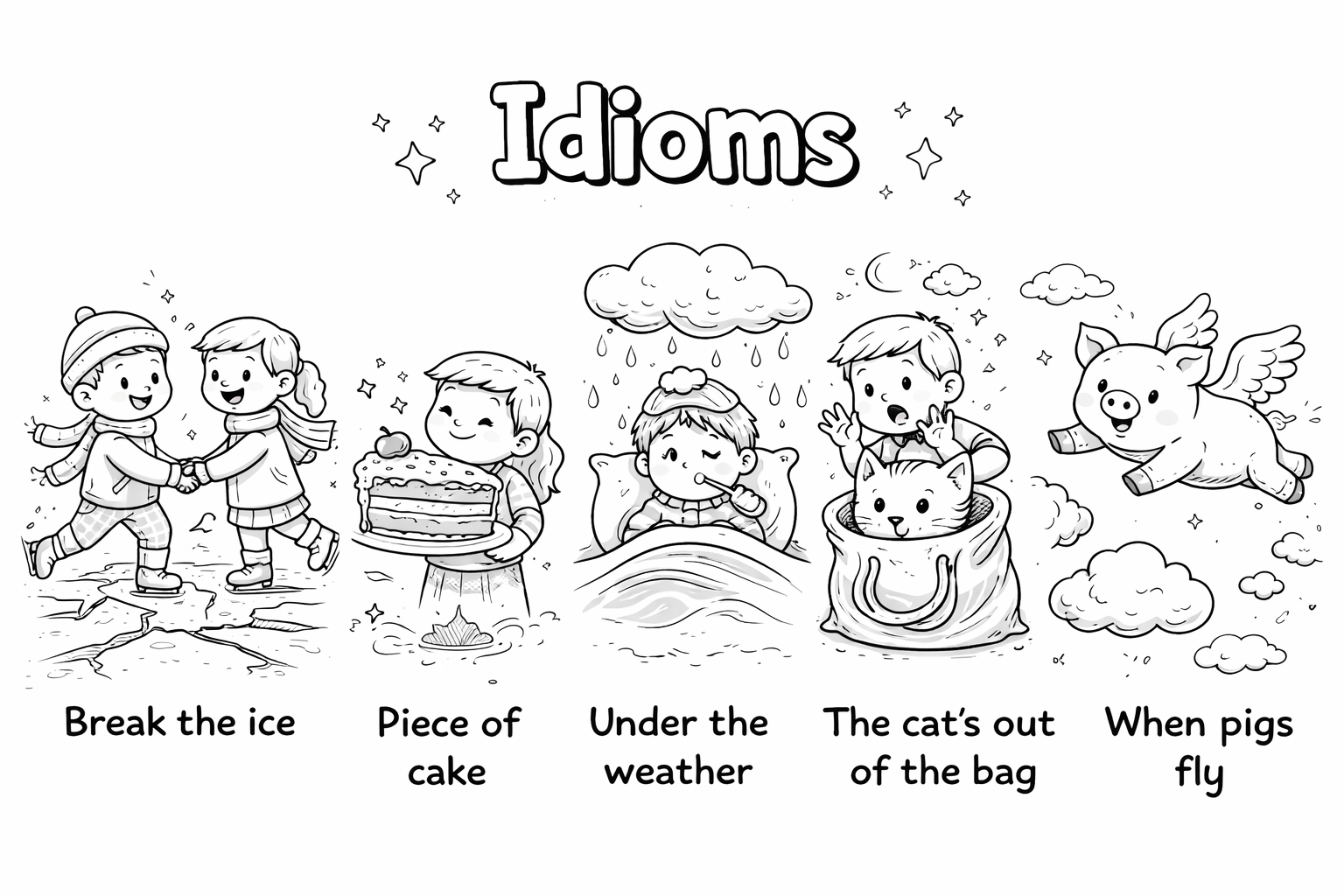
Idiom
We have made a whole separate tutorial on idioms if you want to learn more.
Why idioms matter in the 11+:
They often appear in comprehension texts
They appear in some Verbal Reasoning questions
You must understand the hidden meaning, not just the words
Imagery
Imagery is language that helps the reader see, hear, smell, taste, or feel what is happening in a story.
It creates strong pictures in the reader’s mind.
Imagery
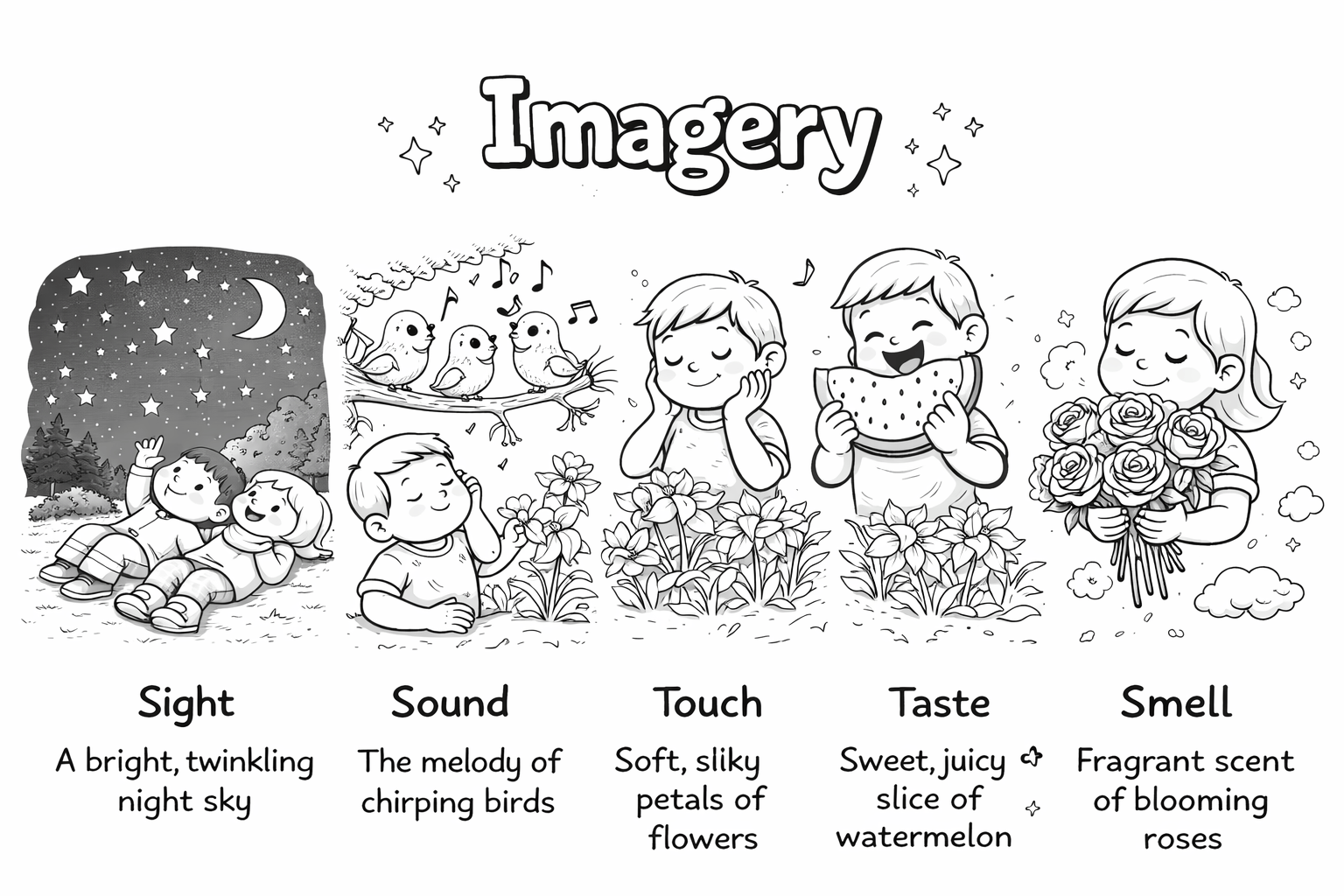
Imagery
“The golden sun melted into the pink evening sky.”
“The warm bread filled the room with a sweet smell.”
“The icy wind stung my face.”
Imagery
Imagery uses:
Sight
Sound
Smell
Taste
Touch
Imagery
Imagery uses:
Sight
Sound
Smell
Taste
Touch
What we see
Imagery
Imagery uses:
Sight
Sound
Smell
Taste
Touch
What we hear
Imagery
Imagery uses:
Sight
Sound
Smell
Taste
Touch
What we smell
Imagery
Imagery uses:
Sight
Sound
Smell
Taste
Touch
What we taste
Imagery
Imagery uses:
Sight
Sound
Smell
Taste
Touch
What we feel
Imagery
Tip:
If the sentence helps you imagine using your senses, it is imagery.
Repetition & Emphasis
Repetition means using the same word or phrase more than once.
Writers repeat words to make ideas stronger, clearer, or more memorable.
Repetition & Emphasis

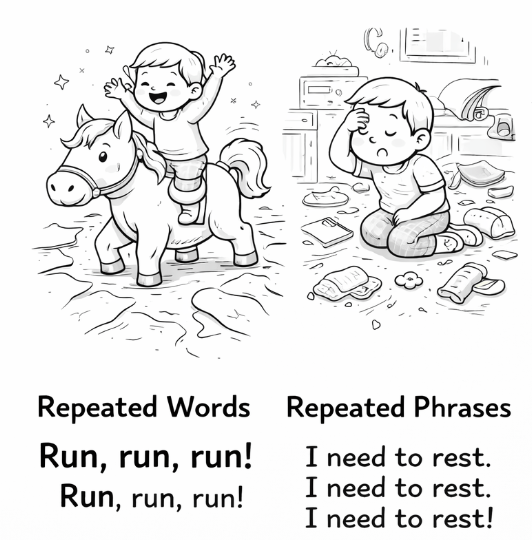
Repetition & Emphasis
More examples:
“To be or not to be”
“It was a very, very cold morning.”
“He wanted to win — win at all costs.”
Why writers use repetition:
To show strong feelings
To highlight important ideas
To create rhythm and impact
Repetition & Emphasis
More examples:
“Run, run, run!”
“It was a very, very cold morning.”
“He wanted to win — win at all costs.”
Why writers use repetition:
To show strong feelings
To highlight important ideas
To create rhythm and impact
Tip:
If a word or phrase is repeated on purpose, it is usually for emphasis.
Rhetorical Questions
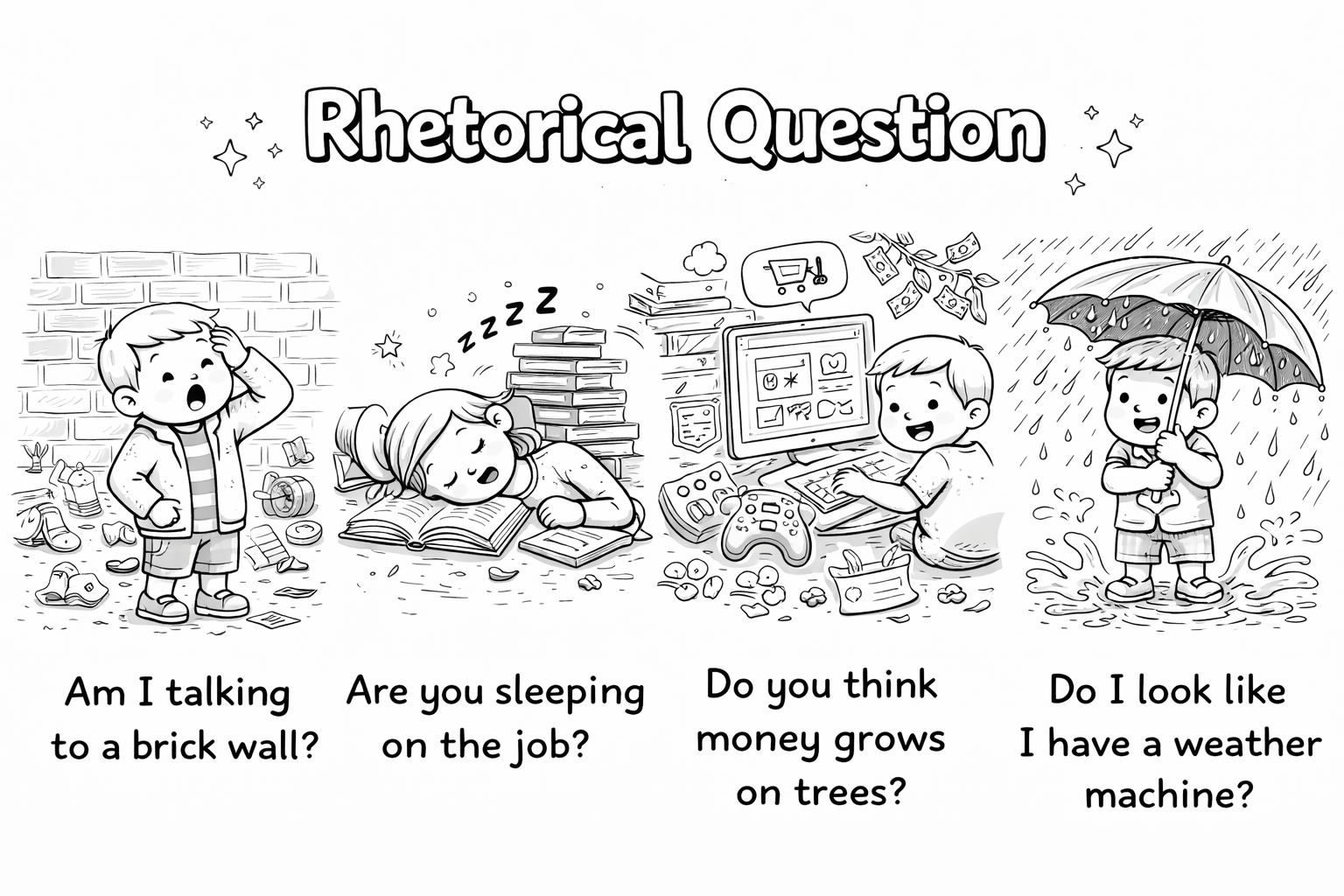
A rhetorical question is a question that does not need an answer.
It is used to make the reader think or to make a strong point.
Rhetorical Questions
Rhetorical Questions
Sometimes it is obvious that a question is rhetorical, but often you would need to judge this based on the context:
Rhetorical Questions
Sometimes it is obvious that a question is rhetorical, but often you would need to judge this based on the context:
Do I look stupid to you?
"
If someone is dressing up in unusual clothes, this could be a genuine question. "Do I look stupid to you in these clothes?"
Rhetorical Questions
Sometimes it is obvious that a question is rhetorical, but often you would need to judge this based on the context:
Do I look stupid to you?
"
But if it is said in an argument, where someone is pointing out something obvious, it is clearly not meant as a real question. It would be a rhetorical question actually meaning "I'm not an idiot"!
Rhetorical Questions
Why writers use rhetorical questions:
To persuade
To show opinion or feeling
To engage the reader
Tip:
If a question is asked but no answer is expected, it is a rhetorical question.
Identifying Devices in Short Texts
Let's practice spotting and identifying some literary devices.
Identifying Devices in Short Texts
“The wind howled like a wolf as the tired trees bent and sighed.”
Identifying Devices in Short Texts
“The wind howled like a wolf as the tired trees bent and sighed.”
"The wind howled" is
Identifying Devices in Short Texts
“The wind howled like a wolf as the tired trees bent and sighed.”
"The wind howled" is
both onomatopoeia and personification.
"Howl" is considered onomatopoeia because it imitates the long, mournful sound made by howling animals.
Identifying Devices in Short Texts
“The wind howled like a wolf as the tired trees bent and sighed.”
"The wind howled" is
both onomatopoeia and personification.
The "wind howled" is personification because it's normally something an animal (like a wolf) or a person does.
Identifying Devices in Short Texts
“The wind howled like a wolf as the tired trees bent and sighed.”
"The wind howled" is
"like a wolf" is
both onomatopoeia and personification.
Identifying Devices in Short Texts
“The wind howled like a wolf as the tired trees bent and sighed.”
"The wind howled" is
"like a wolf" is
a simile
"like a wolf" is a simile because it makes an indirect comparison using "like" or "as".
both onomatopoeia and personification.
Identifying Devices in Short Texts
“The wind howled like a wolf as the tired trees bent and sighed.”
"The wind howled" is
"like a wolf" is
a simile
"tired trees" is
both onomatopoeia and personification.
Identifying Devices in Short Texts
“The wind howled like a wolf as the tired trees bent and sighed.”
"The wind howled" is
"like a wolf" is
a simile
"tired trees" is
a personification
"Tired trees" is a personification because tiredness is a human quality being given to trees.
both onomatopoeia and personification.
Identifying Devices in Short Texts
“The wind howled like a wolf as the tired trees bent and sighed.”
"The wind howled" is
"like a wolf" is
a simile
"tired trees" is
a personification
"bent and sighed" is
both onomatopoeia and personification.
Identifying Devices in Short Texts
“The wind howled like a wolf as the tired trees bent and sighed.”
"The wind howled" is
"like a wolf" is
a simile
"tired trees" is
a personification
"bent and sighed" is
a personification
"trees ... bent and sighed" is a personification too, because again human qualities are being given to trees.
both onomatopoeia and personification.
Identifying Devices in Short Texts
“The stars were diamonds in the sky”
Choose the correct literary device:
simile metaphor idiom
Identifying Devices in Short Texts
“The stars were diamonds in the sky”
Choose the correct literary device:
simile metaphor idiom
Identifying Devices in Short Texts
“The leaves danced in the breeze”
hyperbole personification onomatopoeia
Choose the correct literary device:
Identifying Devices in Short Texts
“The leaves danced in the breeze”
hyperbole personification onomatopoeia
Choose the correct literary device:
Identifying Devices in Short Texts
"Bang! The door slammed shut"
onomatopoeia imagery repetition
Choose the correct literary device:
Identifying Devices in Short Texts
"Bang! The door slammed shut"
onomatopoeia imagery repetition
Choose the correct literary device:
Identifying Devices in Short Texts
"I waited forever for the bus"
hyperbole simile idiom
Choose the correct literary device:
Identifying Devices in Short Texts
"I waited forever for the bus"
hyperbole simile idiom
Choose the correct literary device:
Summary & Key Takeaways
You have learned what literary devices are and why writers use them.
You can now:
✔ Recognise common literary devices
✔ Explain what they mean
✔ Spot them in reading passages
✔ Answer 11+ style questions with confidence
Well done!

Well done! You should now have a very good understanding of literary devices for your 11+ English and Verbal Reasoning.
Remember:
Good readers look carefully at how words are used, not just what they say!