11+ Maths
Ratio and Proportions
Objective: Gain a strong understanding, recognize and express the quantitative relationship between two or more quantities.
Why Ratio and Proportions Matters: Ratio allow us to compare quantities effectively, such as understanding speed or density. Proportions are used in tasks like creating models, scaling recipes, mixing solutions or calculating discounts and interest rates.
Key Ideas:
- Ratio expresses a relationship between two quantities, showing how many times, one value contains or is contained within the other.
- Proportion represents the equality of two ratios.
Introduction to Ratios
- What is ratio? A ratio is a relationship between two numbers showing how many times the first number contains the second.
-
Symbolism:
- Ratio=ab3\text{Ratio} = \frac{a}{b}Ratio= orora:ba:orb a:b, where aaa and bbb are two number.
- Example: The ratio of boys to girls in a class of 2 boys and 4 girls is 2:4, which simplifies to 1:2.

Types of Ratios
-
Part-to-Part Ratios:
-
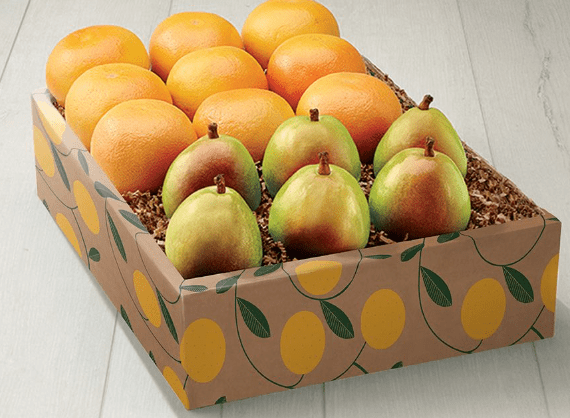
Example: Ratio of pears to oranges in a basket.
-
Formula:applesoranges\frac{\text{apples}}{\text{oranges}}distancetime\frac{\text{distance}}{\text{time}}
-
Ratio =
Types of Ratios
-
Part-to-Part Ratios:
-
Example: Ratio of pears to oranges in a basket.
-
Formula:applesoranges\frac{\text{apples}}{\text{oranges}}distancetime\frac{\text{distance}}{\text{time}}
-
Ratio =
Types of Ratios
-
Part-to-Part Ratios:
-
Example: Ratio of pears to oranges in a basket.
-
Formula:applesoranges\frac{\text{apples}}{\text{oranges}}distancetime\frac{\text{distance}}{\text{time}}
-
Ratio =
or Ratio= 6 : 9
Simplifying Ratios
Ratio =
- Ratio can be simplified, the same way as fractions. To simplify a ratio, divide all parts of the ratio by their greatest common factor (GCF). Always simplify ratios to their smallest whole numbers.
:3
:3
Example:
The GCF (6 ,9) = 3
You can notice that every 2 pears correspond to 3 oranges.
Ratio =
:3
:3
Simplifying Ratios
- Ratio can be simplified, the same way as fractions. To simplify a ratio, divide all parts of the ratio by their greatest common factor (GCF). Always simplify ratios to their smallest whole numbers.
Types of Ratios
-
Part-to-Whole Ratios:
-
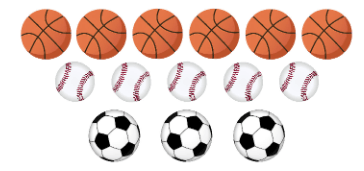
Example: Ratio of basketball balls to total balls.
-
Formula:red marblestotal marbles\frac{\text{red marbles}}{\text{total marbles}
-
Quick Check:
Find the ratio of basketball balls to the total number of balls
Types of Ratios
-
Part-to-Whole Ratios:
-
Example: Ratio of basketball balls to total balls.
-
Formula:red marblestotal marbles\frac{\text{red marbles}}{\text{total marbles}
-
Quick Check:
Find the ratio of basketball balls to the total number of balls
Answer:
Ratio =
or Ratio = 6 : 14
Types of Ratios
-
Part-to-Whole Ratios:
-
Example: Ratio of basketball balls to total balls.
-
Formula:red marblestotal marbles\frac{\text{red marbles}}{\text{total marbles}
-
Quick Check:
Find the ratio of basketball balls to the total number of balls
Answer:
Ratio =
:2
:2
or Ratio = 3 : 7
Do not forget to simplify it.
GCF (6,14) = 2
Introduction to Proportions

-
A proportion is an equation that expresses two ratios as equal.
- A proportion can be written as:
where a,b,c,a, b, c,a, b, c, and ddd are numbers.
- Example: If we consider one half of a full circle, we can write it down as 1:2, which equals to 2:4, or 4:8 and so on. We can write the proportion as:
Solving Proportions
-
To solve a proportion we use the cross-multiplication method.
where a,b,c,a, b, c,a, b, c, and ddd are numbers.
- Example: If 4 oranges cost £2, how much will 10 oranges cost at the same rate?
Answer: The proportion can be set up as:
Where:
-
444 is the number of oranges,
-
222 is the cost for 4 oranges,
-
101010 is the number of oranges for which we need to find the cost,
-
xxx is the unknown cost of 10 oranges.
Solving Proportions
-
To solve a proportion we use the cross-multiplication method.
where a,b,c,a, b, c,a, b, c, and ddd are numbers.
- Example: If 4 oranges cost £2, how much will 10 oranges cost at the same rate?
Answer: The proportion can be set up as:
Where:
-
444 is the number of oranges,
-
222 is the cost for 4 oranges,
-
101010 is the number of oranges for which we need to find the cost,
-
xxx is the unknown cost of 10 oranges.
4 oranges cost £2
10 oranges cost £x
Solving Proportions
-
To solve a proportion we use the cross-multiplication method.
where a,b,c,a, b, c,a, b, c, and ddd are numbers.
- Example: If 4 oranges cost £2, how much will 10 oranges cost at the same rate?
Answer: Using the cross-multiplication method we get:
By dividing the both sides of the equation by 4 we get:
We get that the price for 10 oranges is £5.
Application of Ratio and Proportions
Real-World Examples:
- Recipe Scaling: If a recipe calls for 2 cups of flour for 4 servings, how much flour is needed for 10 servings?
- Map Reading: If 1 cm on a map equals 100 km, how many kilometres does 5 cm represent?
- Medication Dosages: A doctor prescribes 10 mg of medicine per 5 kg of body weight. How much medicine should a 70 kg patient take?
- Population Ratios: In a city of 100,000 people, 60% are adults. How many adults live in the city?
1100=3x\frac{1}{100} = \fr
Application of Ratio and Proportions
Real-World Examples:
- Recipe Scaling: If a recipe calls for 2 cups of flour for 4 servings, how much flour is needed for 10 servings?
- Map Reading: If 1 cm on a map equals 100 km, how many kilometres does 5 cm represent?
- Medication Dosages: A doctor prescribes 10 mg of medicine per 5 kg of body weight. How much medicine should a 70 kg patient take?
- Population Ratios: In a city of 100,000 people, 60% are adults. How many adults live in the city?
1100=3x\frac{1}{100} = \fr
Before we review the solution, try working through these problems step-by-step. You'll be surprised how simple it is!
Application of Ratio and Proportions
Real-World Examples:
1. Recipe Scaling: If a recipe calls for 3 cups of flour for 6 servings, how much flour is needed for 10 servings?
Answer: We need 5 cups of flour for 10 servings.
2. Map Reading: If 1 cm on a map equals 100 km, how many kilometres does 5 cm represent?
1100=3x\frac{1}{100} = \fr
Answer: 5cm on the map represents 500km in real life.
Application of Ratio and Proportions
Real-World Examples:
3. Medication Dosages: A doctor prescribes 10 mg of medicine per 5 kg of body weight. How much medicine should a 70 kg patient take?
4. Population Ratios: In a city of 100,000 people, 60% are adults. How many adults live in the city?
1100=3x\frac{1}{100} = \fr
Answer: In the city live 60,000 adults.
Answer: 70kg person should take 140mg of medicine.
What We Learned About Ratios and Proportions
-
Summary: Ratios compare quantities, and proportions show the equality of two ratios. Mastering ratios and proportions helps with real-world problems like scaling, map reading, and recipe adjustments.
- Proportions help us solve everyday problems, like scaling recipes, comparing prices, or working out distances on a map.
- Ratios can also help us make decisions, such as adjusting ingredients for a larger or smaller batch of something or figuring out the most efficient way to mix materials.
-
Remember: Ratios and proportions are not just mathematical tools—they are ways of thinking critically and solving problems that we encounter daily!